

When meaning became a vibe
Good Vibes Only

We used to argue about what was true.
Now we mostly argue about how things feel.
In the post truth era, facts are optional and emotion is mandatory. Feeds move fast, trust thins out, and the simplest way to survive the noise is to lean on mood. If it feels right, that is enough.
Meaning has not disappeared. It has loosened into atmosphere. Instead of saying something, we set a vibe and let that stand in for thought, for politics, for a sense of where the world is going.
Vibes are what we reach for when truth feels too heavy and power feels untouchable.
Mood as a shortcut for truth
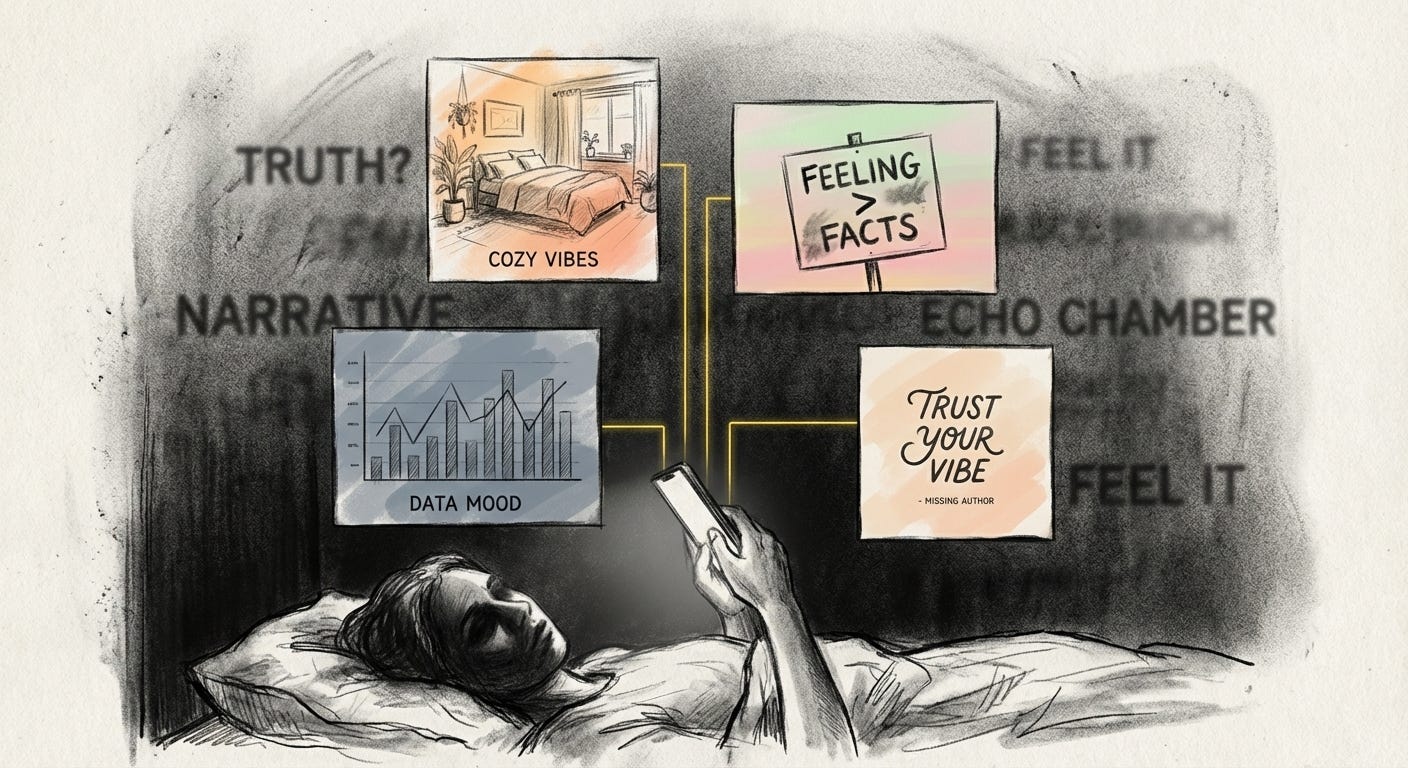
Open your phone. You are not being asked to read. You are being asked to sense.
A short video with no context. A caption that is half joke, half confession. A song under a montage of someone’s day. A quote with the author name cropped off. None of it explains itself. All of it carries a tone.
Platforms reward whatever creates a fast feeling. The post that makes you nostalgic, angry, soothed, righteous. There is no time for careful claims, so the culture starts speaking in shorthand. Aesthetic. Mood. Vibe.
The unit of meaning moves from sentence to scene. A bedroom in orange light. A protest sign framed against a sunset. A chart that looks complicated enough to feel smart, whether or not it is accurate. You are invited to feel with it, not think through it.
This is not just cultural drift. It is infrastructure. Ranking systems are tuned for engagement, not truth. Content that fits the emotional temperature of a group travels further than content that asks that group to change its mind.
In post truth culture, “true” increasingly means “matches the way my world already feels”.
Mood becomes a shortcut for truth. We stop checking against reality. We check against the atmosphere we live in.
Platforms as mood machines
The major platforms do not present themselves as political or philosophical projects. They describe what they do as connection, creativity, community. In practice, they operate as vast mood machines.
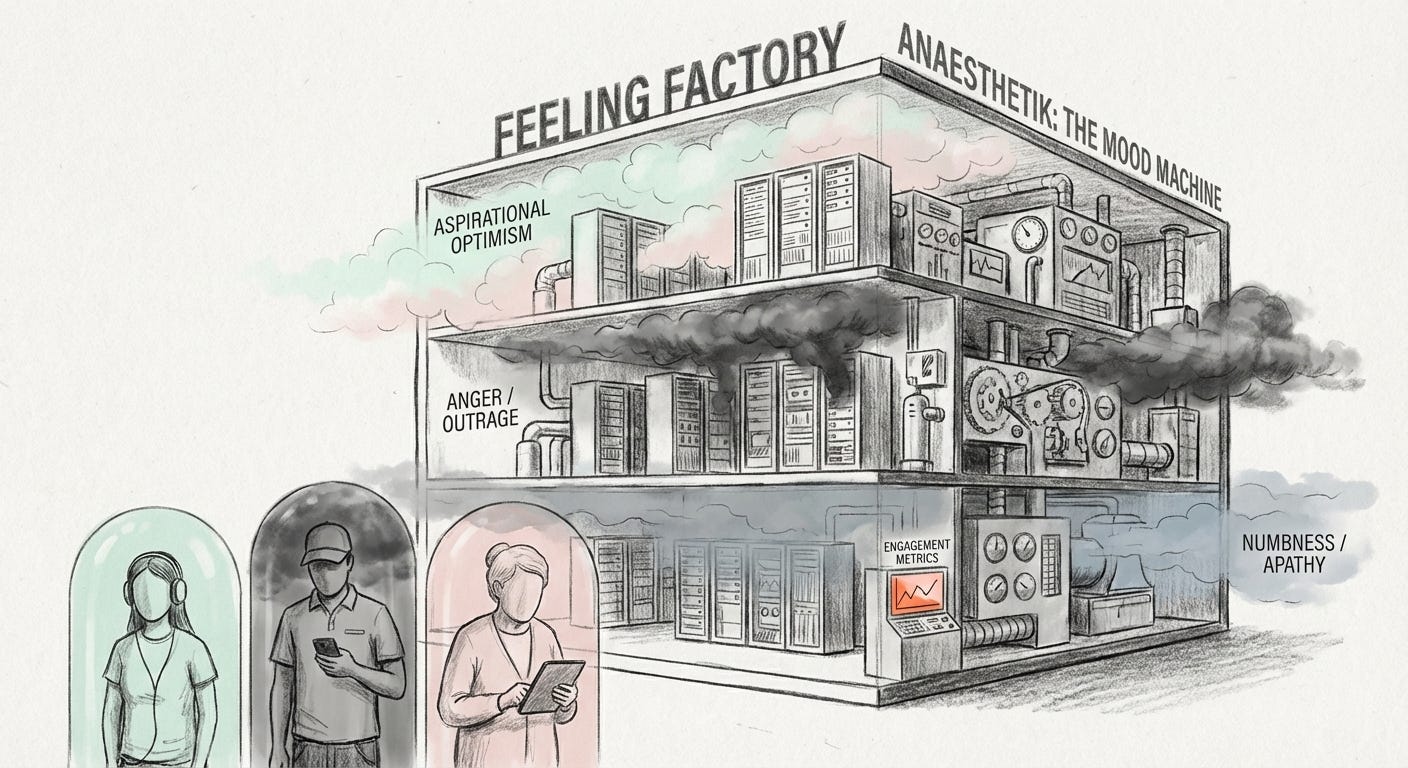
Recommendation systems learn what keeps each segment of people scrolling. For some, it is gentle escapism. For others, constant outrage. For others, ironic detachment. Each group is placed inside a slightly different emotional weather system and told this is the world.
There is a socio technological story here. The code that curates your feed is written far away from you. It optimises for time spent, not shared understanding. It cannot tell the difference between a careful explanation and a conspiratorial rant if both produce the same spike in attention.
Over time, feeds develop a house mood. A soft, aspirational optimism. A simmering anger at institutions. A constant undercurrent of crisis. Facts appear inside that mood and take on its color. The same event can feel hopeful in one feed and apocalyptic in another.
The people who design these systems tend to live in one part of society. Salaried, insulated, based in a few cities. The people who live under the outcomes are everywhere. A rural teenager whose main window on politics is a short video app. A delivery worker whose breaks are filled with algorithmically sorted content. A grandparent who treats the feed like a newspaper.
The platform makes money either way. The specific mood is less important than the fact that there is one and that you stay inside it.
Vibe politics
Politics has adapted. Campaigns and movements now treat vibe as a primary tool, not an afterthought.
A candidate can be described as “not left, not right, just a vibe”. A party can position itself as “the feeling of order” or “the energy of change” without committing to much on paper. The visual language does a lot of the work. Clean typography, intimate video, lo fi music, crowd shots that look like music videos.
On the surface, this looks like modern communication. Underneath, it is a way to hold coalitions together without resolving contradictions. Different groups can project their own hopes onto the same mood. One person sees safety. Another sees rebellion. Another sees nostalgia. No one has to say which it really is.
This suits a post truth environment. If people do not trust official numbers or expert reports, you do not win them with spreadsheets. You give them an atmosphere that feels like the version of the country they already carry in their heads.
The cost appears later. When policies are made, they are written in precise language. Those documents do not travel. What travels is the headline, the slogan, the edited clip, the vibe. People are left to live with the concrete outcomes of decisions that were sold as a feeling.
Vibe politics lets power move quietly while the public argues about mood.
Authoritarian projects can present themselves as calm restoration. Extractive projects can dress up as green renewal. As long as the surface tone feels right to enough people, the underlying structure can remain unseen.
Class, control, and who sets the mood
Vibe culture often presents itself as democratic. Anyone can post. Anyone can curate an aesthetic. Anyone can “set the tone”.
In practice, control is uneven. To shape a mood at scale, you need reach, time, and technical support. You need teams to watch the numbers, tweak the message, and buy distribution when the algorithm is not enough.
Governments, parties, and large companies have all of this. They can coordinate campaigns across screens and spaces. They can test which phrasing and which visual style generates the right emotional response. They can flood a channel with a particular climate of feeling.
Most individuals cannot. They live inside moods they did not design. They scroll through aspirational lifestyles, financial advice, political content, and techno optimism, all coded for someone else’s ends. They are told that their own “mindset” will determine their fate, while the background systems remain off camera.
There is a socio political split here. Audio rooms, glossy campaign videos, citizen content that looks spontaneous but is seeded from above. One group experiences the feed as a creative field they can play in. Another experiences it as a set of options that always tilt toward consumption or allegiance.
Technology amplifies this. Automated accounts, synthetic video, and cheap editing tools make it easy to generate huge volumes of mood aligned material. Whole candidate personas, protest aesthetics, or lifestyle grids can be assembled in a studio or a lab and then released as if they grew organically.
The line between genuine atmosphere and manufactured one gets thinner. For most people, the distinction barely matters. It all feels real because it feels continuous.
Shortcuts in a tired society
None of this works only because of design tricks. It also works because people are tired.
Work is unstable. Housing is fragile. News cycles are constant. Verifying every claim is beyond most people’s capacity. Vibe offers a fast way to sort the world.
If something fits your emotional map, it enters. If it clashes, it is labelled negative, toxic, cringe, out of touch. Friction is treated as an insult to your chosen atmosphere, not as possible evidence that you might need to update it.
This is where post truth slides into numbness. The world can be burning and your interface still feels aligned. War footage, environmental collapse, and financial scandal arrive in the same visual language as recipes and outfits. The mood stays coherent while the facts refuse to.
For the already comfortable, this functions as a buffer. The screen smooths reality into a manageable stream of impressions. For those without that security, the same mechanism hides how stacked the conditions really are. They see vibes of empowerment, hustle, self care, individual resilience, floating on top of structural constraints no one names.
Vibe is a comfort product in a society that no longer wants to look directly at its own arrangements.
What disappears when vibes win
When meaning becomes a vibe, a few things quietly thin out.
Specific positions. It is hard to hold a clear line without puncturing the mood. So stances soften into gestures. “We care.” “We stand with you.” “We believe in better.” The words hover. They do not land on detail.
Accountability. If most of what you emit is tone, it is hard for anyone to pin down what you actually promised. When critique comes, you can say it was a joke, a metaphor, a misunderstanding. Everything stays half serious, half performance.
Language that cuts. Words that would introduce conflict or clarity sound harsh inside a culture tuned to aesthetic harmony. So we get slogans and captions that hint instead of state. The edges that could catch our attention are filed away.
On the surface, this looks kind. It reduces visible arguments. It keeps timelines “positive”. Campaigns feel inspiring. Brand worlds feel safe.
But it leaves us thin. A world made of vibes is hard to navigate when something real breaks through. A flood that wipes out the backdrop. A policy that removes a right. A blackout that takes away the feed itself. Suddenly mood is not enough, and we realise how little practice we have had in thinking together, only in feeling together.
A culture trained to live by vibe will struggle to decide what to do when the mood finally breaks.
Friction, on purpose
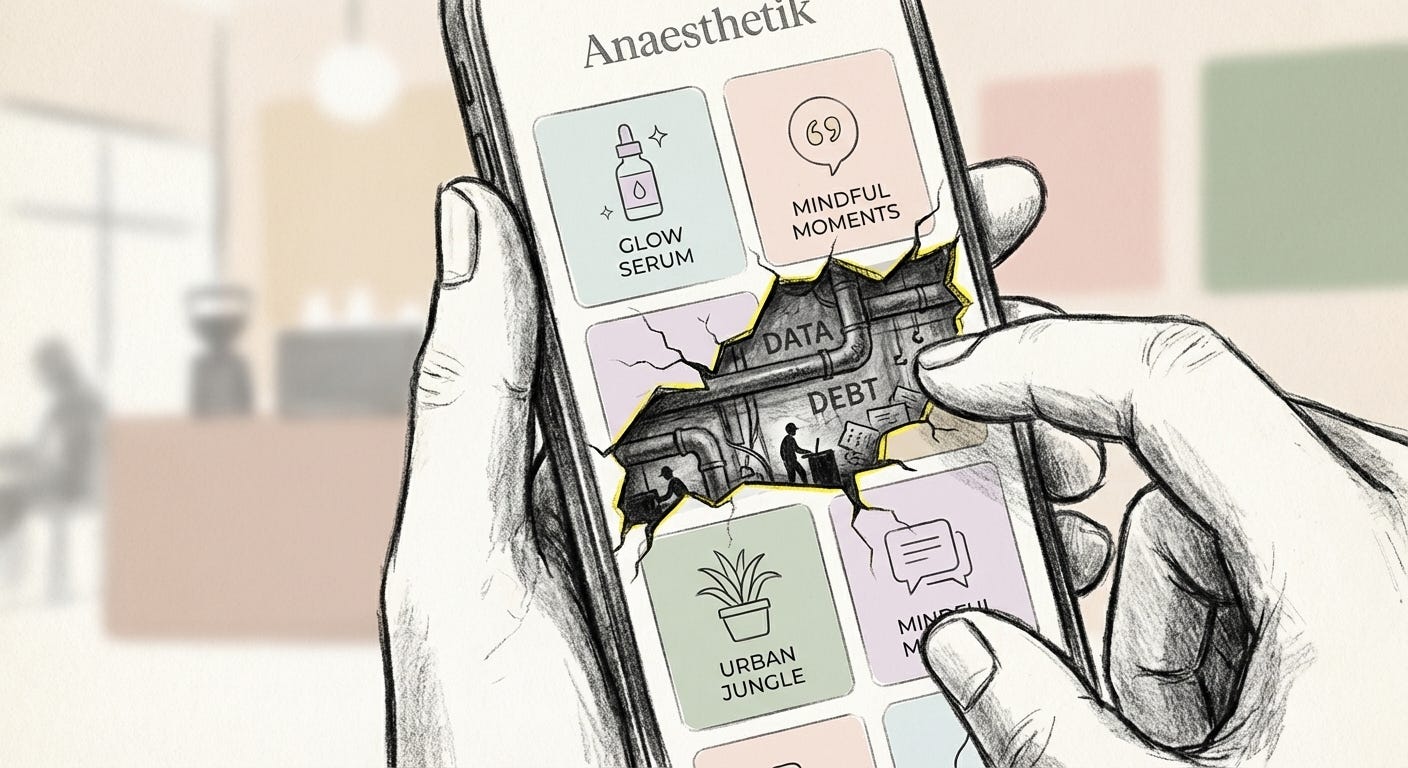
Anaesthetik sits inside that gap. In the small lie we live with when we treat atmosphere as understanding.
The aim is not to kill mood or nostalgia or aesthetic pleasure. Feeling matters. Style matters. They simply cannot stand in for meaning, policy, and shared reality.
The work now is to notice when we are being handed a vibe instead of a thought. To see when a room, a feed, a speech, or a product is asking us to feel as if something is true without ever showing the mechanism.
That noticing is a kind of friction. It is the small catch in the scroll, the pause in the lobby, the moment with a poster or a clip where you ask who benefits if I stop here and do not ask another question.
In a post truth world built from mood and machines, that pause might be the last honest habit we still have.
Visual archive → afterimage
You’re reading Anaesthetik. The connection got louder. We feel less.
You have detailed the problem very well. Any proposed solution?
The solution providers are the ones who are sought.