

Platform Trained Eyes
Our interfaces mold us

In the blue light of the feed, our eyes have picked up new habits.
Swipe. Pause. Skip.
We move without thinking, but always in rhythm with the platforms that trained us.
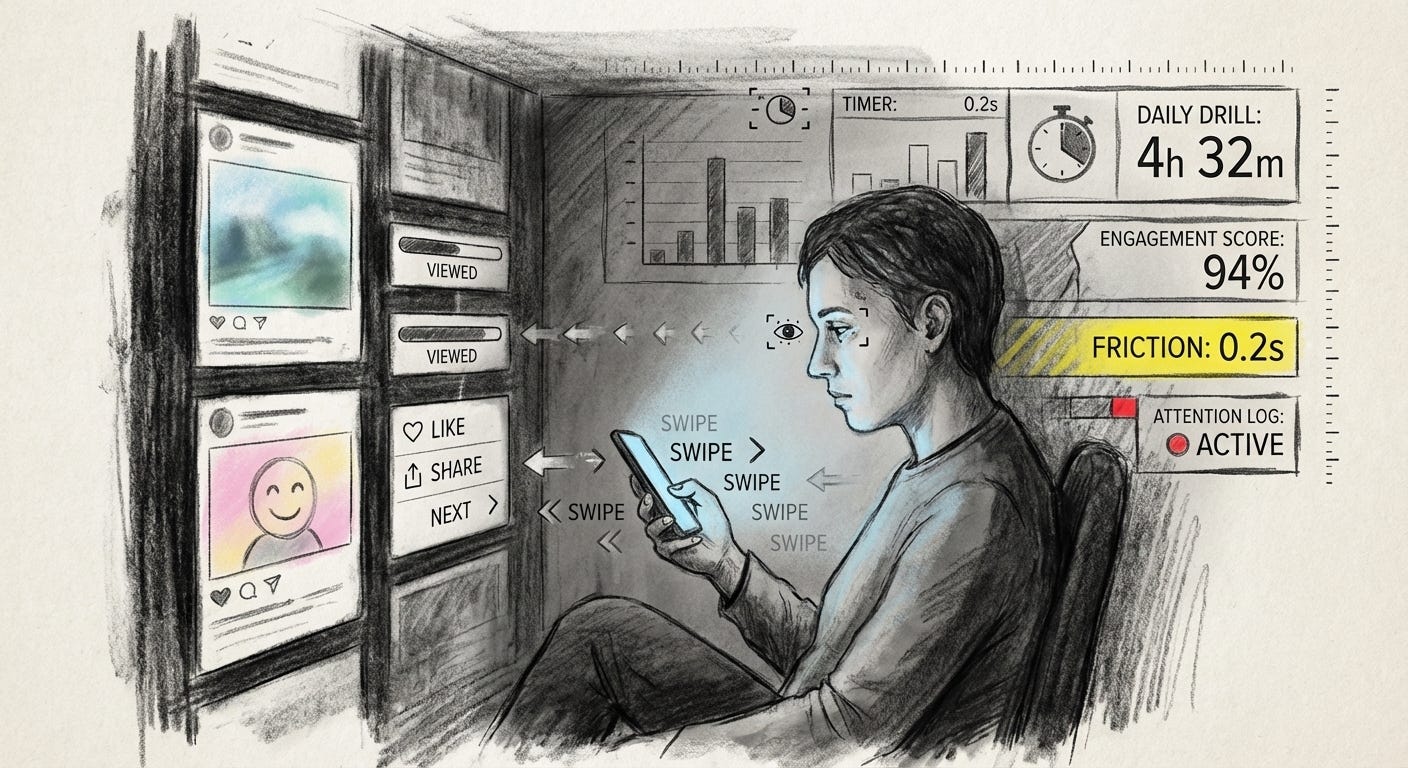
We do not just look at screens now. Screens look back, measuring every hesitation. Over time, our perception has been tuned like a sensor array: efficient at spotting what pops, ruthless at filtering what does not. What feels like casual scrolling is a daily drill in how to see.
We have become expert at skipping, and the platforms count on that expertise.
Repetition as Reflex
Feeds on TikTok, Instagram, YouTube and their smaller cousins are assembled for speed. They test which images make us tap, replay, share. Anything that grabs us once is copied and pushed again in slightly altered form. Same beat, new face. Same mood, new caption.
The logic is simple: repeat what works until it does not. Every pause is logged. Every flick away is recorded as a micro-refusal. The system narrows our world around the things we react to fastest.
This is not just about content. It is about reflex. When designs, formats and moods loop over and over, our brains learn to recognise them in a fraction of a second and discard them just as fast. That early feeling of discovery is brief. The repetition turns style into noise.
Platforms adjust to our boredom too. When we start skipping a trend en masse, the recommendation systems soften it, remix it or push the next template. The choreography tightens. We are trained to respond on cue, and the cues are trained on us.
Trends that Turn into Wallpaper
The training shows up most clearly in how visual trends move from fresh to invisible.
Cinematic B-roll fatigue
There was a moment when a cinematic TikTok vlog felt new. Soft focus coffee, light across a desk at golden hour, slow cuts of trains and pavements. It looked like effort. It looked like care.
Then the recipe spread. Editing apps, preset packs and tutorials made the language cheap to copy. Soon every day-in-my-life vlog came with the same aerial shots of oatmeal, the same lens flares, the same wistful track.
The first time, these choices signalled intention. Now they signal template. The platform-trained eye recognises the sequence and slides past it. Even TikTok has started to reward rougher, less polished clips again. Not because the platform became less commercial, but because the old form stopped holding attention.
The cinema is still there. It just sits in the background, like a poster you stopped seeing long ago.
The staged chaos of photo dumps
On Instagram, the photo dump arrived as a small refusal. Instead of one perfect image, people posted carousels of blurry nights, half-eaten food, weird street corners. It looked like a shrug at the platform’s polished surface.
But the shrug was learned too. As the format spread from friends to influencers to celebrities, a clear pattern emerged. The same kinds of shots returned: bathroom mirror flash, sunset from a plane, a pet half out of frame, a plate, a concert blur. Randomness became a style with rules.
Writers at places like the Guardian noticed the irony. The dumps that claim to be loose and careless are often tightly curated, slotted neatly into the same rhythms as branded content. We sense it without needing proof. Our eyes clock the pose inside the mess and keep moving.
Authenticity, once marketed, becomes just another filter.
Pastel productivity and the copy-paste life
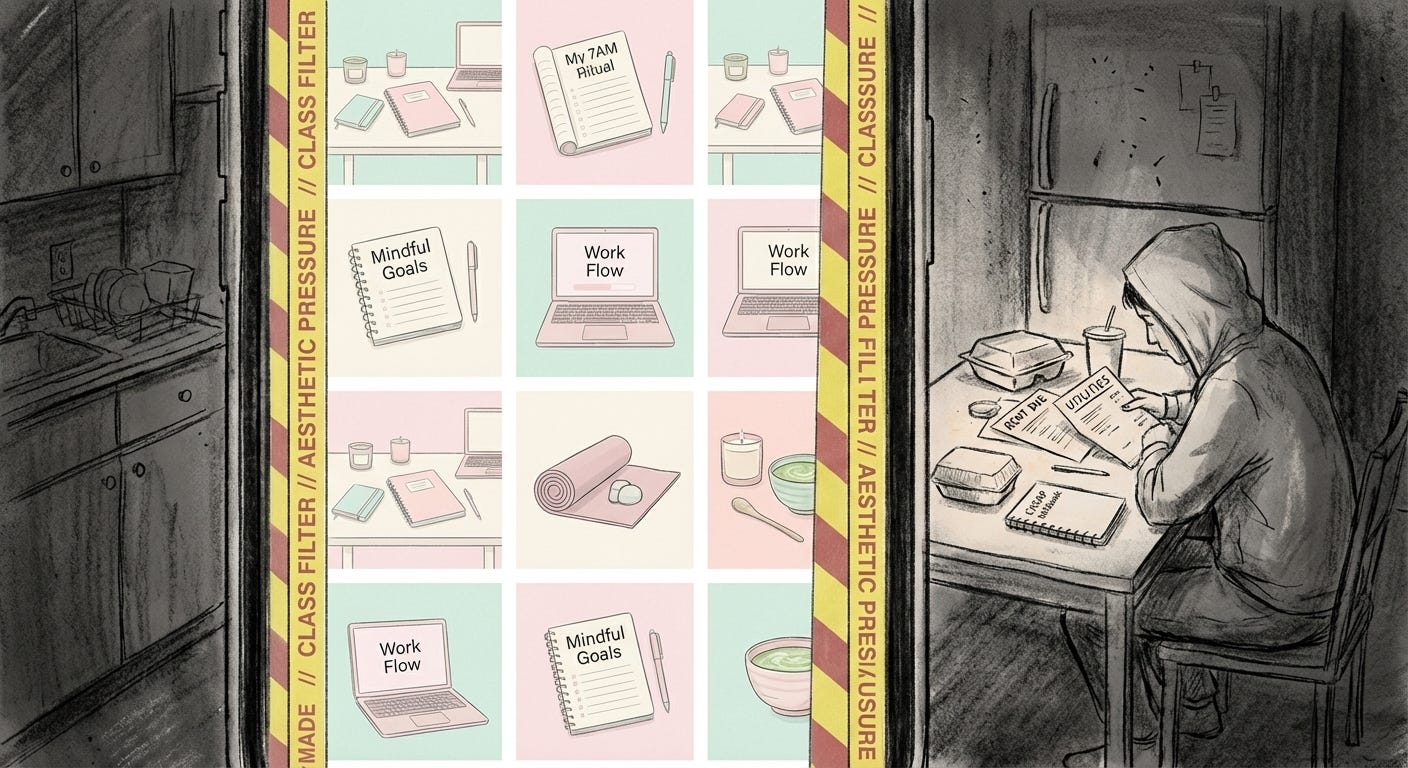
On YouTube and TikTok, the productivity genre has its own visual grammar. Pastel dashboards, clean Notion boards, bullet journals with neat handwriting. Morning routines that begin at six, feature yoga, skincare, matcha, a spotless desk and a glowing laptop.
In one college paper, a student described skipping through a long queue of these routine videos in five-second jumps. The faces changed, the items did not: the same candles, the same bowls, the same fonts and foods. A strict aesthetic flattened every difference.
These scenes promise control in an unstable world. They are soothing for those who can buy the items, afford the time, absorb the pressure. For everyone else, the message is quieter and harsher. If your life does not look like this, it is not optimized yet.
At a glance the visuals are gentle. In bulk they form a grid of expectation. Our eyes learn to read them as one unit and dismiss them as soon as they appear. Comfort becomes a background pattern that no longer comforts. It simply sets the bar.
Who Gets the Comfort
Platforms sell coherence. They promise that if you show up and look, the world will make sense in a certain style.
For brands, the pattern is a gift. They can slide their products into existing trends with minimal friction. A pastel drink on a pastel desk. A sneaker in a photo dump. A logo in a cinematic B-roll. The audience has already been trained to read the scene as desirable.
For the people making the content, the pattern is both ladder and cage. It offers a route to visibility if you copy it well enough. It punishes you if you do not. Deviations that do not algorithmically perform sink without trace. The cost of experimentation is invisibility.
For viewers, the comfort is temporary. The more we see the same three or four aesthetics, the less we feel them. Fashion writers at Vogue have described this as a flattening of online aesthetics: distinct visual cultures compressed into what plays best in the feed. What started as expression becomes a form of quiet sorting. Taste is sorted by what you can afford to stage. Attention is sorted by how fast you recognise the code.
Choreography of Attention, Flattening of Feeling
There is timing to our boredom now.
Millions of people open their phones and skip the same kind of shots within a similar window of weeks or months. There is no vote, no coordination. But the analytics line up. The platforms register a collective dip and pivot away. Our fatigue feeds the next design decision.
We learn to see on the platform’s schedule, not our own.
This efficiency has a cost. When our vision is always tuned for the next spike in contrast, slower or stranger forms of beauty fall out of frame. Anything that resembles a tired format is discarded, even if it carries something careful or new inside.
For those already buffered by money and time, this is another layer of background noise. They can still step outside the feed, go to galleries, travel, find other channels where attention stretches. For those who live more inside the phone and work under tighter conditions, the feed is a primary window on the world. When that window flattens, it compresses not just style but possibility.
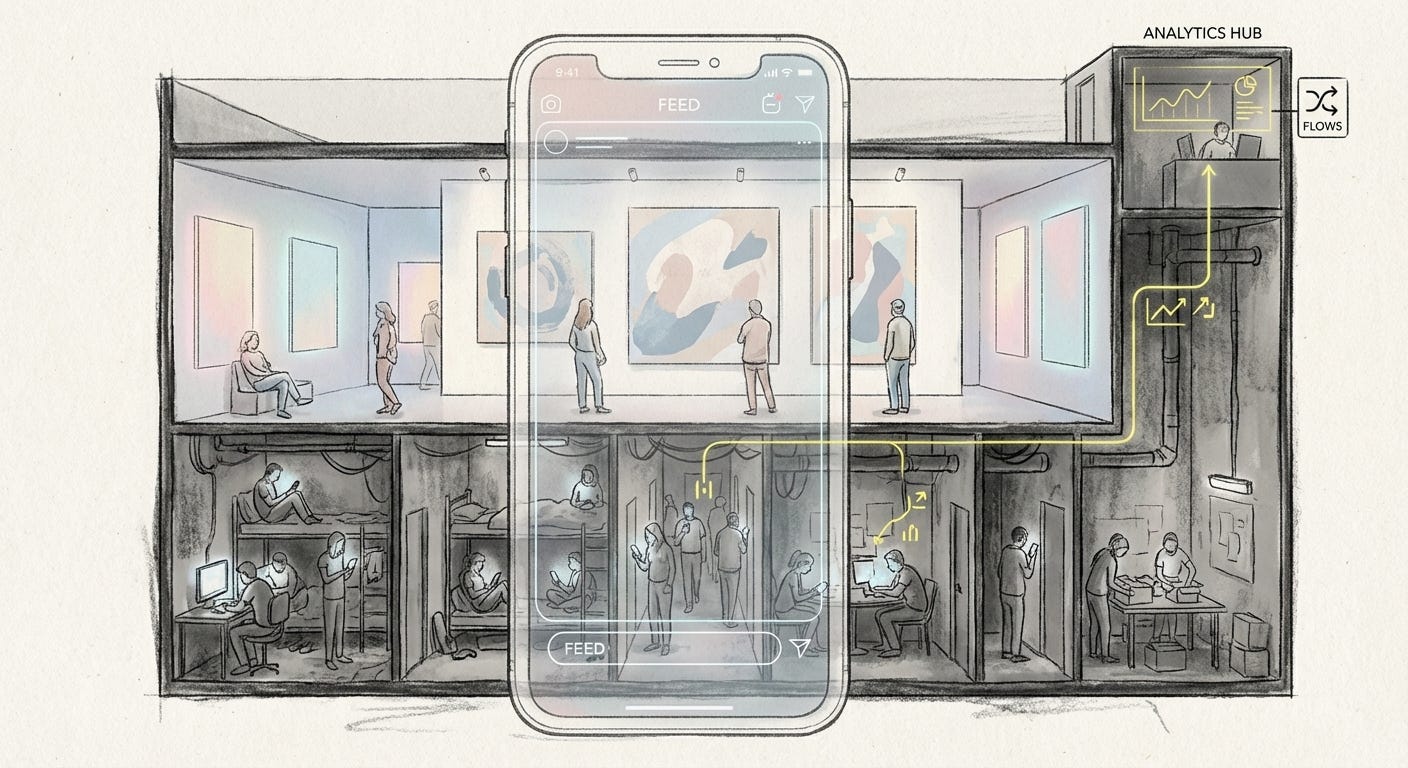
The numbness is not dramatic. It is quiet, cumulative and rational from the system’s point of view. Less friction. More time on platform. Cleaner data.
Learning to See the Training
There is a small opening in all this.
Platform-trained eyes do not only recognise content types. They can also start to recognise the pattern of their own training. The moment you feel a familiar boredom rise in front of a perfect desk or a chaotic dump, there is a chance to notice the choreography rather than just continue the step.
That awareness does not dissolve the system. It does not free us from advertising budgets, venture targets or watch-time metrics. But it can thicken our sense of what is being done to our vision, and on whose behalf. At minimum, it can make the numbness legible.
Our eyes are not failing. They are performing exactly as they were taught. The question is what else they might learn to linger on, once we start treating the feed itself as something to look at, not just through.
Visual archive → afterimage
You’re reading Anaesthetik. The connection got louder. We feel less.