

Interfaces That Want You to Forget
Fleeting Moments, Unknown Consequences

Your messages vanish. Receipts fade. The notification tray clears itself.
On screen, the past keeps slipping just out of reach.
It feels tidy. It is also a kind of training. Interfaces are slowly teaching us that nothing needs to stay.
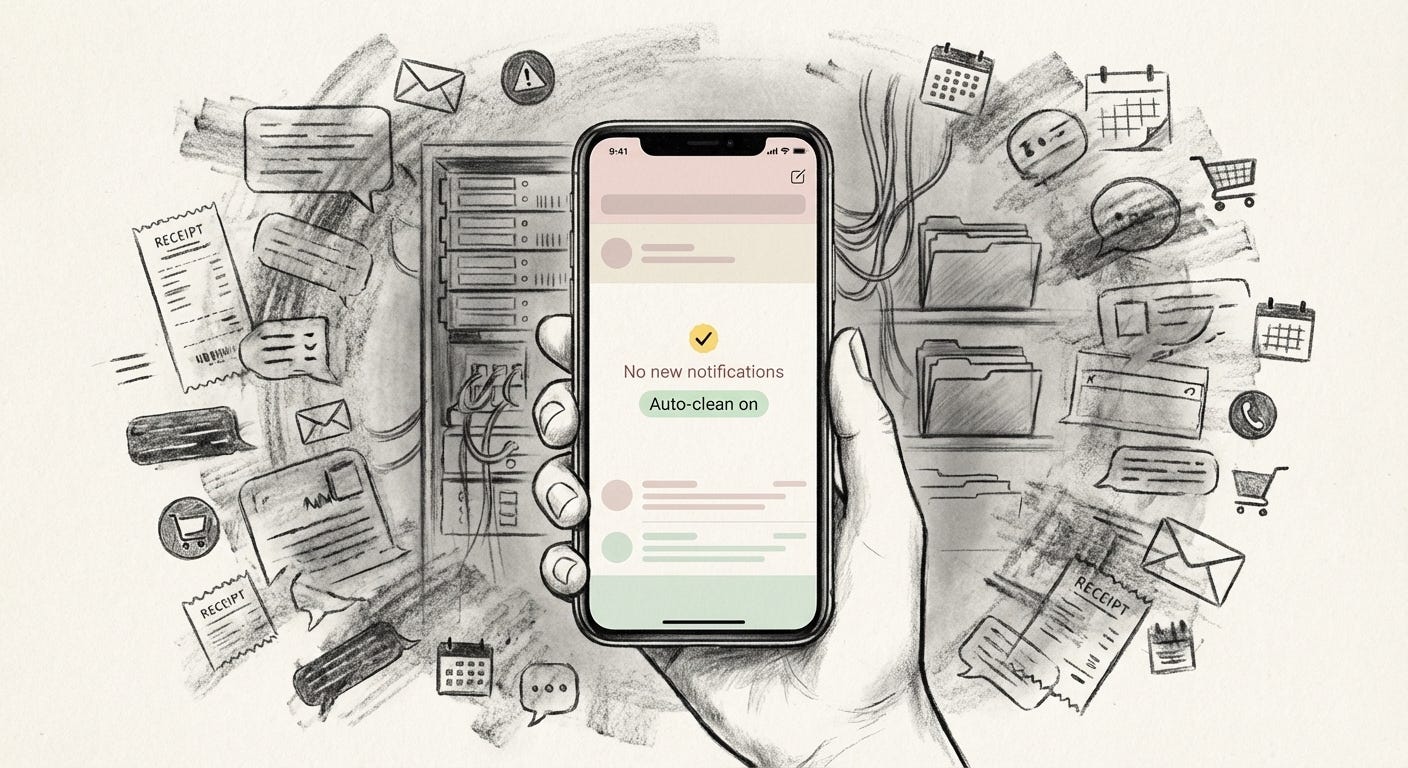
The interface forgets on your behalf, and calls it care.
The calm surface of built in forgetting
Modern interfaces do not just show less. They erase.
Messaging apps ship with timers. Browsers clear histories on a schedule. Notifications are designed to arrive loudly and disappear quietly. Sometimes you choose this in a settings menu. Often it arrives as the default.
On the surface, the argument is soothing. Less clutter. More privacy. You are busy; let the system clean up after you. Deletion is framed as a service.
Underneath, the logic is different. The screen forgets in the one direction that is safest for institutions and most disorienting for you. Conversation threads thin out. Transaction details get buried or auto archived. Activity logs rotate away faster than any dispute process.
The interface forgets what would be useful for you to point to later.
The systems behind it keep exactly what is useful for them.
Ephemeral chat as a normal tone
Private messaging is the most obvious zone where forgetting has become a feature.
Snapchat’s entire interaction model is built on messages and images that disappear after they are viewed or after twenty four hours. Other encrypted messengers like Signal and Telegram offer self destruct timers and “view once” modes that wipe a message from your device after a set period.
There are real reasons to welcome this. In hostile homes, at risky jobs, in countries with thin legal protections, the ability to let conversations evaporate can feel like a shield. For some people, the right to disappear a chat is a form of safety.
But the same pattern also softens responsibility. Screenshots become the only real record. Timed chats lower the friction of saying whatever the moment demands, without the weight of a visible trail. Abuse, coercion, or simple bad faith can move through that space, wrapped in the mood of intimacy and privacy.
What looks like mutual forgetting is rarely symmetrical. You lose the thread. The company still tracks metadata, backups, device IDs, patterns of contact. The conversation is gone for you, not for the infrastructure.
Stories, ghosts, and disposable presence
Social media has turned ephemerality into a house style.
Instagram and Facebook stories already trained people to broadcast in twenty four hour windows. Threads adds “ghost posts” that quietly archive themselves after a day. The post is treated like vapor by design. It flashes across feeds, then slips into a private archive or disappears from public view.
The tone is playful. You are encouraged to “just post,” to avoid overthinking, to treat each update as light and reversible. Social presence becomes a stream of impressions with no obligation to last.
This is comforting for brands and public figures. Testing a message in a story feels low risk. Saying something half formed feels safer if it will be gone tomorrow. Yet the asymmetry holds here too. Screenshots circulate. Aggregator accounts capture “vanished” content. Platforms track performance even after deletion.
For regular users, the effect is different. Life is experienced as a chain of short term displays, each one important in the moment but blurry in retrospect. What you said last week is technically saved somewhere, but not in a way that anchors memory or helps you connect cause and effect over time.
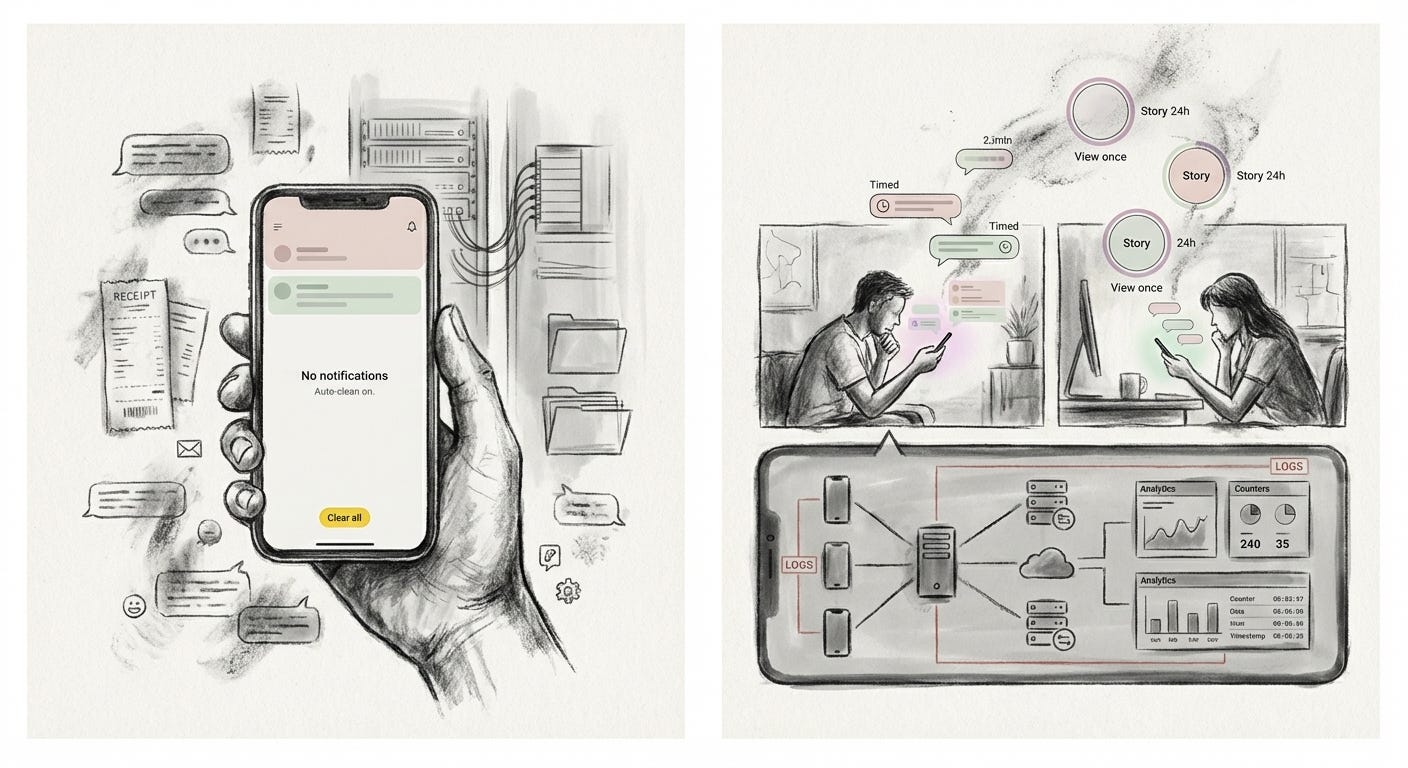
Ephemeral formats make expression feel free, and consequences feel faint.
Receipts that fade and logs that reset
The same pattern appears in more mundane tools.
Some expense and receipt apps automatically clear out old tickets after a fixed period. They present this as decluttering. Hard drives stay light. Interfaces stay clean. You are nudged to believe that if you needed a document, you would have done something with it already.
Smart home devices also quietly prune their own history. A doorbell camera might keep motion footage for thirty or sixty days by default before overwriting it. Searching further back requires a paid plan, or is simply impossible. The thin slice of time you are allowed to see is just enough to handle daily irritation, not enough to construct a longer view.
For people with resources, this is an annoyance at worst. They can pay for extended storage, export logs, lawyer up if needed.
For people under pressure, vanishing records are more dangerous. A deleted notification can mean no proof of a charge. A purged camera log can mean no clear record of harassment or abuse. Auto expiring receipts turn disputes into “your word against theirs.”
The interface frames this as efficiency. In practice, it relocates the burden of record keeping back onto the person with the least tools to manage it.
What trimmed pasts do to feeling
Built in forgetting changes more than convenience. It changes how events feel.
When the trail is short, every moment becomes strangely light. Fights in a chat thread do not sit there on screen, daring you to re read them. Posts that felt huge yesterday vanish from your public profile. Notifications stack up and vanish while you are in a meeting. Life becomes a series of emotional spikes with little visible residue.
This can be a relief. It can also be a quiet form of anesthesia. Without records, patterns are harder to see. Harassment looks like a few isolated flares instead of a sustained campaign. Price changes look like random swings instead of a creeping trend. Policy shifts vanish under rolling updates and auto dismissed banners.
Calm, empty interfaces support a calm, empty sense of history.
You are left with how things feel now, not how they have been.
For those already secure, this lightness reads as freedom. You can log off and trust that the important structures of your life are backed up elsewhere. For those in precarity, the same lightness feels like drift. If the interface forgets and you cannot afford private archives or legal support, then the past becomes harder to prove.
The people who design and fund these systems sit inside thick layers of documentation, contracts, backups, and compliance. The people who live under them are offered disappearing messages and fading receipts.
The politics of who gets to remember
Forgetting is presented as hygiene. In practice, it is policy.
Interfaces decide what counts as clutter and what counts as a record. They push frictionless deletion on the user side while maintaining dense memory on the institutional side. This is not neutral. It shapes who can point to a trail, who can contest harm, who can reconstruct how we got here.
Screens that constantly wipe themselves clean are not just a style. They are a quiet proposal for how much history you are allowed to hold in your hand.
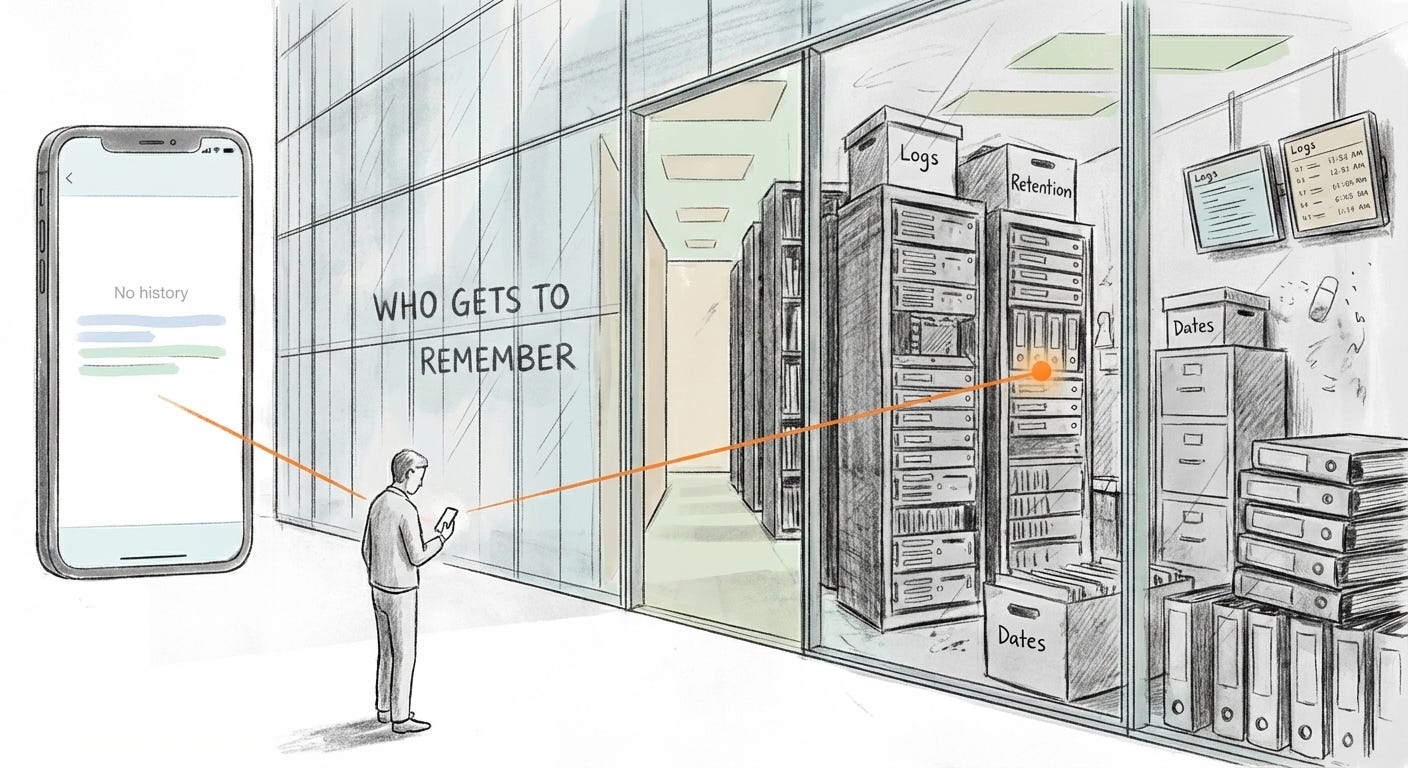
A world where everything is temporary on your side of the glass, and almost nothing is temporary on theirs, is a world where power will always have the better memory.
Visual archive → afterimage
You’re reading Anaesthetik. The connection got louder. We feel less.