

How Long Do You Look
Led By The Gut

The one second test
Your thumb moves before you notice it. Scroll, pause, scroll.
A fraction of a second catches, then you are already somewhere else.
That tiny pause is no longer just a feeling. It is a metric.
Platforms treat the moment your eyes hesitate as proof of value. A post that wins half a second survives. One that does not is buried. Attention has always flickered. What is new is that every flicker is now counted, sold and used to train the system that will ask for more.
A pause is no longer a feeling. It is a data point.
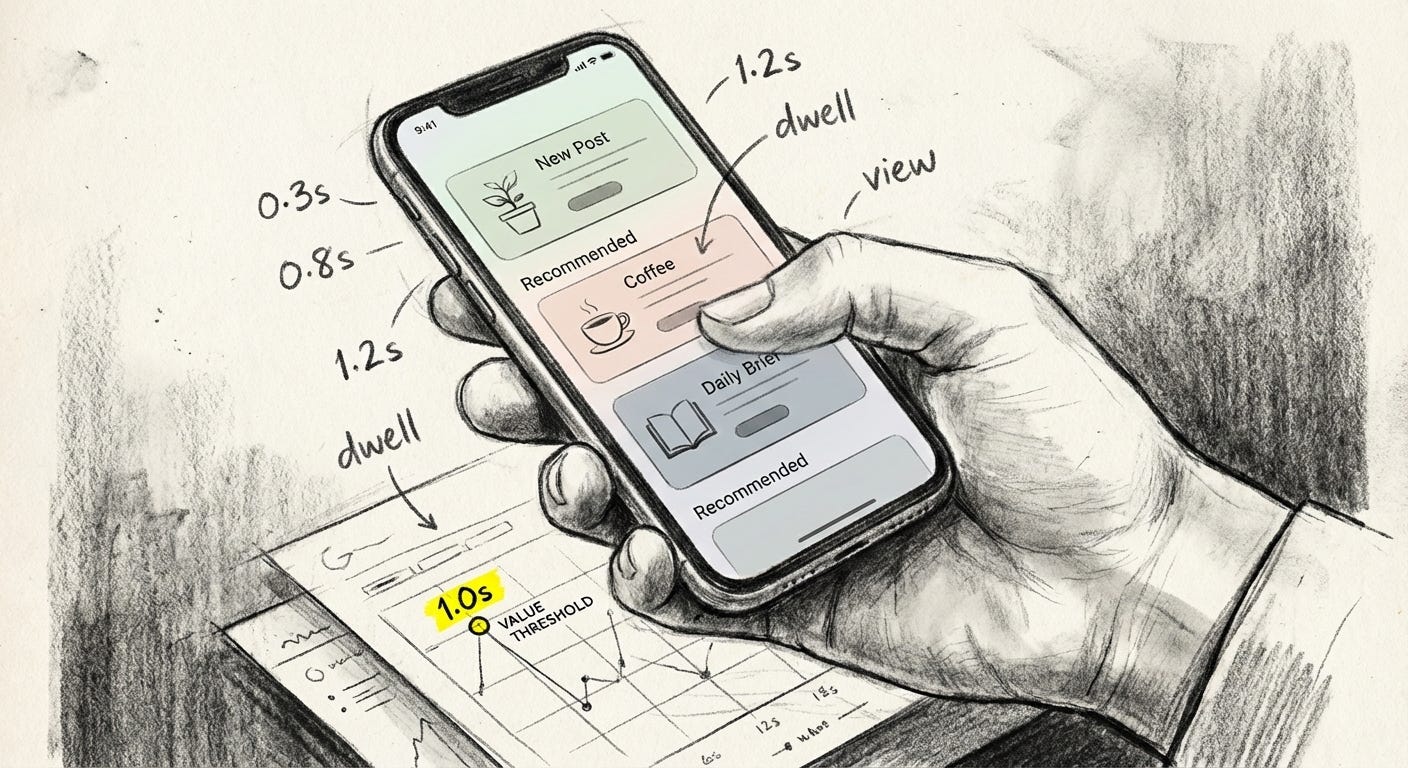
Micro-movements as metrics
The feed looks casual, but it runs like a lab.
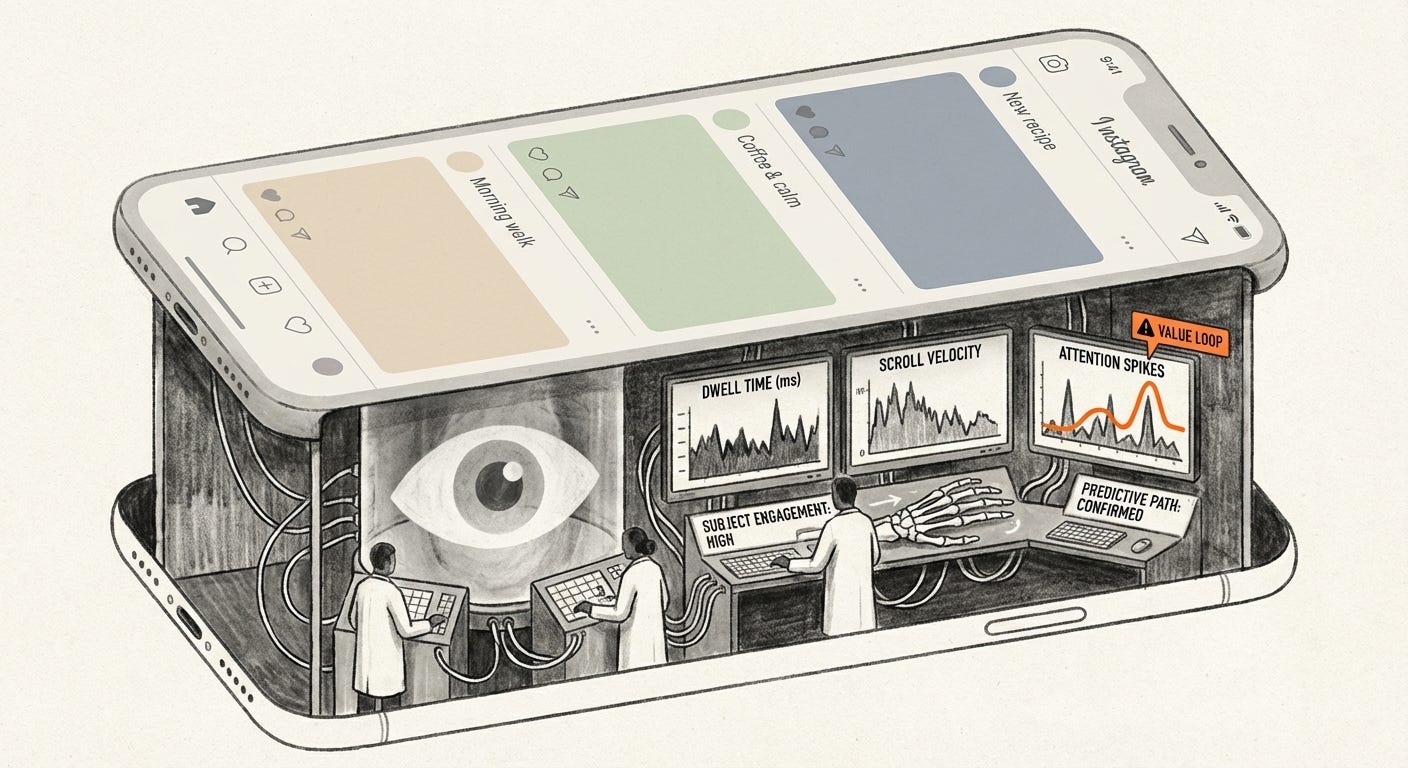
Every gesture is recorded. Apps measure how long a post stays on your screen and call it dwell time. Short videos are scored by how many seconds you watch before you swipe. TikTok treats a seamless replay as a fresh view and now treats completing the loop as one of its strongest success signals. A perfect loop almost dares you not to watch twice.
Design keeps you in motion. Autoplay means the next clip starts without asking. Infinite scroll removes natural stopping points. Full screen modes block out surrounding apps and even the clock. Your role is simple: keep moving. The system’s role is to turn each tiny movement into data.
From the platform’s side, there is nothing small about micro-attention. A scroll is preference. A pause is interest. A replay is desire. Each gesture feeds back into a model that will adjust what you see next, then next, then next again.
Designing for the flicker
Once the rules of the lab are clear, everyone inside it starts to adapt.
Creators learn to hack the one second window. On TikTok, some lock their gaze straight into the camera so the viewer feels held for a beat. Others polish loops until the end and the beginning blur. If you do not see the cut, you watch it twice and the view counter climbs.
Advertisers adapt too. Auto-playing video slides into feeds where static banners once sat ignored. Movement, jump cuts and mini narratives are used to pierce the numbness of the scroll. The point is not to tell a full story. It is to win just enough time that you do not flick away.
Even still images are rebuilt around the glance. On platforms like YouTube, studies of thousands of thumbnails show a convergence on the same tricks: over-sized text, high contrast, extreme facial expressions, hints of danger or surprise. The thumbnail is not really a picture. It is a trap for your peripheral vision.
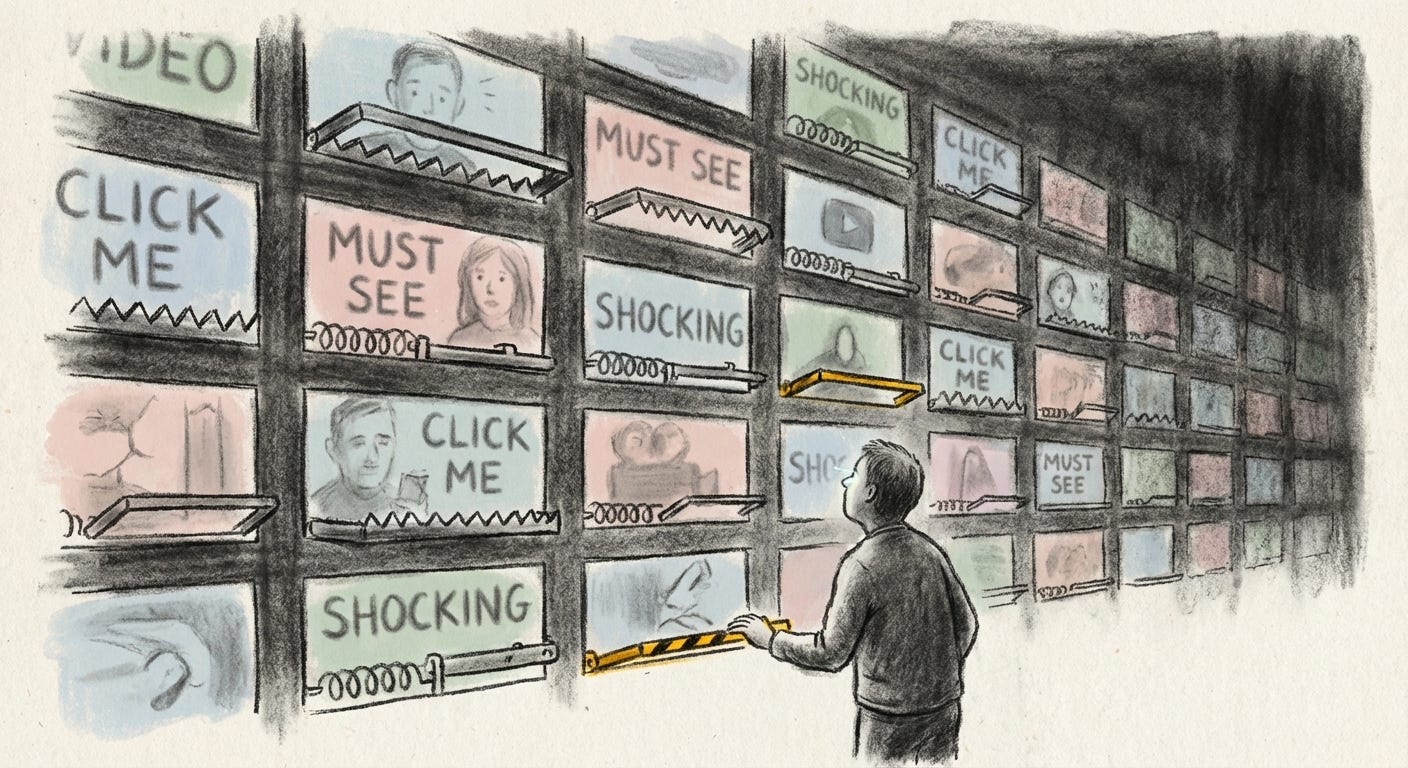
What looks like creativity is often calibration. Creators and brands work to please a machine that rewards what can be recognised and reacted to in an instant. Those who can afford strategy teams and design budgets get better at it. Those who cannot are easier to ignore.
The thumbnail is not really a picture. It is a trap for your peripheral vision.
When attention stops landing
There is a cost to training our eyes this way.
If the feed rewards only what pops in under a second, our habits of seeing change to match. We get faster at spotting shock, drama and exaggerated emotion. We get worse at staying with anything else. Long arguments, quiet images, complex stories start to feel like they are asking for too much.
Researchers who track media use describe the same pattern: heavy social scrolling erodes patience. Deep concentration becomes harder to reach. The attention economy does not just compete for time. It reshapes what sustained attention feels like and who has any left.
The burden is not shared evenly. For people whose income now depends on these platforms, the pressure to perform micro-attention tricks is constant. They must optimise for loops and thumbnails or disappear. For viewers with more secure lives, the stakes are softer. The feed is a background hum that quietly lowers the ceiling on how long anything can hold.
What looks like harmless entertainment becomes an infrastructure of shallow looking.
Looking without seeing
In a system that counts every glance, we end up looking at more and seeing less.
Visual archive → afterimage
You’re reading Anaesthetik. The connection got louder. We feel less.